I gave this dvar Torah on Feb. 8, 2020 at the Narayever. After a few years’ absence for family health reasons I am thinking of relaunching this blog. If this goes well, I will post the other two divrei Torah I have written over the past 15 years (after kids and after the period where I would just wing it with notes on index cards). I apologize for the odd formatting. Everything changed on WordPress in the years I was away.
In this week’s parsha the Israelite slaves are freed from Egypt, as they flee the Egyptians chase them in a dramatic scene (you have all seen the movie) and attempt to trap them at the Red Sea. Moses splits the sea, they walk through the dry land, and the Egyptians drown.
After this the Israelites rejoice by singing two songs: the Song of the Sea and the Song of Miriam. Because of this, today is known as Shabbat Shira, the Shabbat of Song. In keeping with the theme, I am going to explore these songs and I will to turn to popular song as well as more traditional commentary.
First, we have Song of the Sea led by Moses which starts:
.אָז יָשִׁיר-מֹשֶׁה וּבְנֵי יִשְׂרָאֵל אֶת-הַשִּׁירָה הַזֹּאת, לַיהוָה, וַיֹּאמְרו לֵאמֹר אָשִׁירָה לַיהוָהכִּי-גָאֹה גָּאָה סוּס וְרֹכְבוֹ רָמָה בַיָּם
Moses and the people of Israel sang this song to God; they said I will sing to God, the highly exalted: the horse and his rider were thrown into the sea.
Exodus 15:1
Then we have The Song of Miriam:
.וַתִּקַּח מִרְיָם הַנְּבִיאָה אֲחוֹת אַהֲרֹן, אֶת-הַתֹּף בְּיָדָהּ; וַתֵּצֶאןָ כָל-הַנָּשִׁים אַחֲרֶיהָ, בְּתֻפִּים וּבִמְחֹלֹת
.וַתַּעַן לָהֶם, מִרְיָם: שִׁירוּ לַיהוָה כִּי-גָאֹה גָּאָה, סוּס וְרֹכְבוֹ רָמָה בַיָּם
Miriam the prophet, the sister of Aaron, took a timbrel in her hand; and all the women went out after her with timbrels and with dances. Miriam sang to them: Sing to God, the highly exalted: the horse and his rider were thrown into the sea.
Exodus 15:20-21
In both cases, the leader sang and everyone responded.
How do we know everyone sang? For the Song of the Sea it says Moses and the Children of Israel sang. The song of Miriam is usually described as something only the women sang in response to Miriam. However, a closer reading of the text by Prof. Wilda Gafney, an episcopal priest and bible scholar indicates that everyone sang this song as well even if only the women danced with timbrels.
Gafney notes that Miriam says Sing to God. Shiru the word sing, is in the imperative form of the verb in Hebrew. Yes, Hebrew has a verb conjugation form dedicated to telling people what to do. Make of that what you will. In Hebrew, until recently, the male plural was used for both all-male and mixed groups, while a female-only group had its own special plural. The imperative form for males or a mixed group is Shiru. For a group of women only, the word would have been Shirena. Since Miriam says Shiru we know everyone sang.
So now that we know that everyone sang, both times, we can ask a more compelling question. Where did they get those timbrels?
These are slaves with very few possessions leaving in a rush (remember the dough didn’t even have time to rise) and they are able to whip out timbrels. So, how did they have timbrels?
Rashi also wondered about this. He quotes Mekhilta de-Rabbi Ishmal saying that the women were so confident that there would be redemption that they took timbrels out of Egypt.
Or as Prof. Lori Lefkovitz puts it, “Faith is packing your drum.”
My next question is: How did they know the words?
They have just gone through the death-defying escape scene and then they start singing. There is no mention of Moses writing the songs on a tablet or teaching them the song. That seems like a nutty, kind of nerdy question, right? So, you know the rabbis of the Talmud (Sotah 30b-31a) asked it too.
Rabbi Akiva taught that Moses sang the entire song, and the Israelites repeated after him with the leading phrase of each verse, repeating it after each verse, like a mini-chorus.
Rabbi Eliezer son of Rabbi Yosi said that Moses sang a phrase and the Israelites responded after him by repeating the phrase. This technique, where you feed people the next line of a song they don’t know the words of, so that a group can all sing together, especially when done line by line, quickly on the off-beat, is know in my house as “being Pete”.
This is because folk singer Pete Seeger was famous for using this technique to facilitate group singing.
As an aside, I guess my family should call this technique “being Moses” now, since the rabbis say Moses invented it.
Pete Seeger believed in the power of communal, singing and thought that it creates holiness. He said :
No one can prove a damn thing, but I think that singing together gives people some kind of a holy feeling. And it can happen whether they’re atheists, or whoever. You feel like, ‘Gee, we’re all together.’
New York Times, Feb. 10, 2008
Which is kind of what the Tosefta has to say about how everyone knew the words. The Tosefta says that the spirit of God came over them so they could sing together.
I have a theory of how everyone knew the words. Before I get to why that, I want to revisit what they are celebrating with the song.
They are celebrating the end of 400 years of slavery, which means generations of oppression. Even if they are free, their oppression isn’t instantly erased. There is a lot of intergenerational trauma, that will not end with their liberation – as we see in the Torah multiple times. They are fearful and anxious. They are constantly complaining to Moses. They don’t trust Moses or God to provide for them. They panic when their leader, Moses, is absent and quickly make a substitute leader, the golden calf. When the spies return from the land of Israel, they refuse to believe good news about their future. These are all common and understandable reactions to trauma and oppression.
This type of intergenerational trauma is sadly relevant to us today. We are coming to realize that the trauma of the Holocaust didn’t end with liberation, or the state of Israel. There are second and third generation reverberations on an individual level and trauma for us as a people. It is hard to be a good parent for example when you own parent was a slave or victim of the Holocaust. Similarly, the suffering of American slavery didn’t end with emancipation or civil rights. Nor did the pain of first nations people end with an apology or the closing of Residential schools.
But along with intergenerational trauma, I think there is also intergenerational hope and faith.
Melissa Wood Bartholomew, is a Christian minister, graduate of the Harvard Divinity School and racial justice facilitator is also the great-great granddaughter of slaves, Susan and Moses. Recently she visited the plantation where her ancestors were enslaved and tried to imagine what enabled them to not just survive, but to pass on a kind of protection that reached her grandfather. Though her grandfather grew up without electricity or running water, not far from where his grandparents had been enslaved, he became a pastor, a follower of Dr. Martin Luther King, a civil rights leader and a person who created hope.
She writes:
My grandfather describes how as a little boy he would sit at grandma Susan’s knee as she rocked in her rocker and joyfully sang spirituals. She would share memories of her childhood enslaved, forced to labor ten to twelve hours a day picking soybeans and corn. Despite being enslaved most of her life and still living in the midst of struggle, she kept a song in her heart. She proudly described her dear Moses as the “light of her life”.
Just as the women brought their own drums because they had faith that they would be saved, I believe the Israelites knew the words of the song of redemption because they wrote it and sang it and practiced it.
Prof. James Kugel, while arguing a completely other point, raises evidence that the song of the Sea was not spontaneously invented at the Exodus. He notes that it does not mention the splitting of the sea, or the crossing on dry land but it does mention the Egyptians sinking like lead which doesn’t make sense if they were standing on the dry land when the sea closed over them.
All of Kugel’s points are consistent with an imagined or hoped-for redemption song written in advance, where the exact details of the redemption are not yet known. I suggest that the Israelites wrote this song because they knew they or their children or their children’s children would be saved. Indeed, songs of redemption more meaningful if we already know the words, if the songs connect us to our past and to people who prepared us for this moment.
As Lin Manuel Miranda writes:
Legacy. What is a legacy?It is planning a garden you will never see.
I wrote some notes at the beginning of a song someone will sing for me.
Hamilton, The World was Widen Enough, (Thanks R.C.)
If we write the songs of joy and redemption and pass them on, it also enables us to be present, in some way, at redemptions that come in the future, after us. We may not be there physically, but at that joyous moment they will be singing our song.

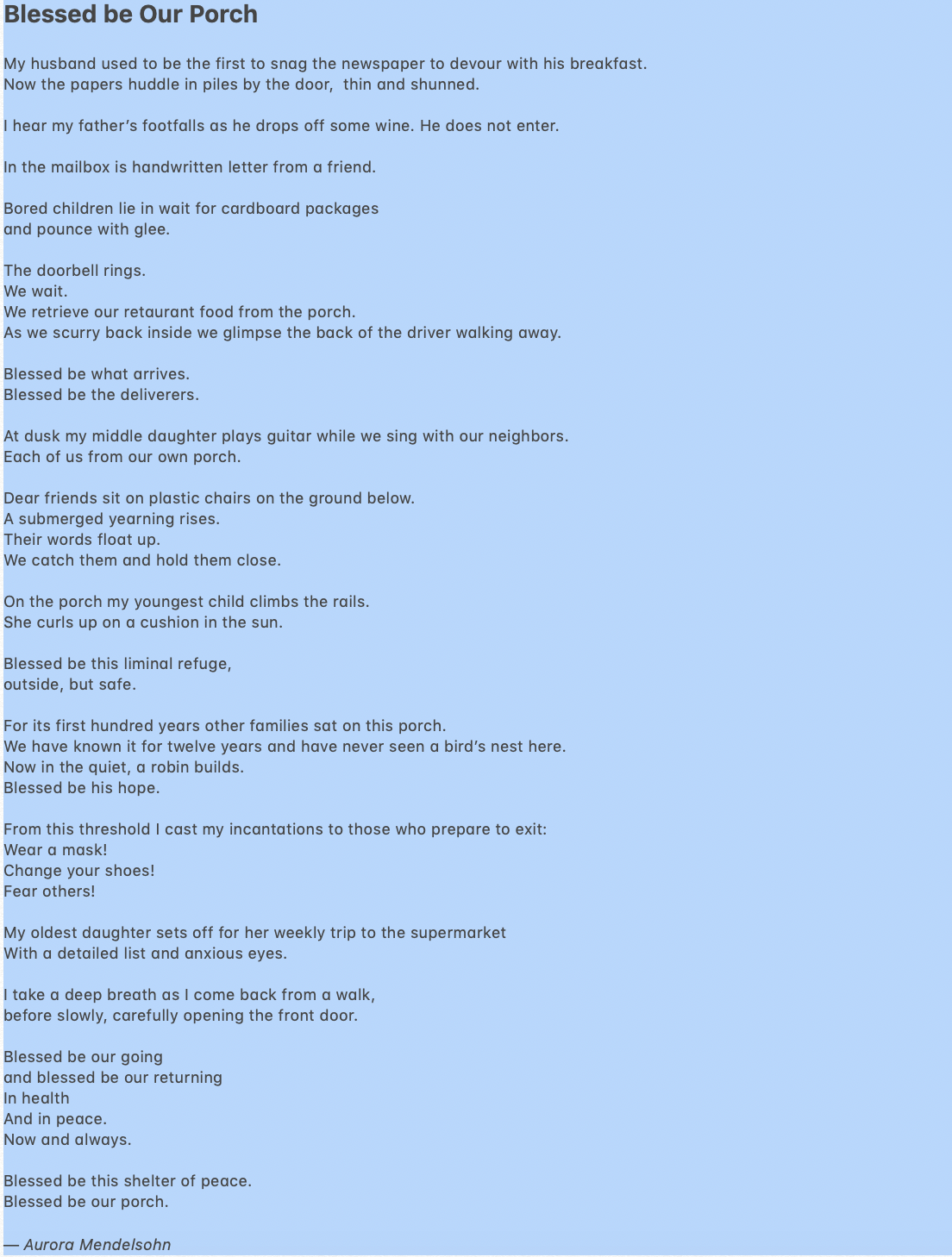 Blessed be Our Porch

 Listen to a Recoding by Sara Borer

 Rainbow Tallit Baby